
Conversation

“The single biggest problem in communication is the illusion that it has taken place”

George Bernard Shaw

Danny has been in some form of speech therapy since he was about 3 years old. At first, it was to coax out as many intelligible words as he could give us; then, it was to help him craft and deliver more complex phrases and sentances.

Eventually he developed a reliable playbook of volleys, if you will. “Hi, how are you?” “I’m fine, how are you” “Have a great weekend!” If you only need to talk to him for a minute, you might not understand why he is still in therapy. He speaks just fine; in fact he talks all the time.

But speaking and communicating are two completely different things. Which is how we have landed at his current, and only, speech goal: conversation.

This is a complicated endeavor; make no mistake that – should you find yourself engaging in authentic conversation with an autistic – what you are experiencing could well be a laborious act of love. For Danny, conversation means that first he must be fully present with you. Any of the extra noise of his mind has to be actively silenced, not just tuned down. He then has to hear the things you say and draw a picture in his mind of the items or the experiences so that he has an image in his mind to reference as the back and forth continues. Assuming that he has been able to do these things, he then needs to craft a response that makes sense (and not just to him: a response that would make sense to you) and assuming that there isn’t something already in the playbook or some wayward movie script that will get the job done, he needs to flip through the file cabinet in his head to find the word he knows was right here the other day…..where did it go….

Conversation does not come easily for that child, but the times that he has invited me into one have been some of the most sacred moments of being a mother that I have experienced. On the other hand, as a person with many many words and a strong desire to use them, communicating with him has been some of the most humbling.

Because in order to communicate with him I have to slow down; pare down. I have to consider how he is feeling and what he is in the position to receive. I need to edit and review the words before I release them. Most of all, I have to be patient.

This year, because of distance learning, I have been in earshot of his speech sessions with his teacher at school. Some of the things that she works on with him seem like the simplest concepts but they make a big difference in forming relationships.

  • Look at the person who is speaking; what does their facial expression say?
  • Listen to the things they are saying and respond in a way that shows you care about what they have said.
  • Don’t talk over them, don’t be in a hurry to turn the conversation back to something you like.
  • If you disagree with something they say, don’t get angry. Ask them why, and then listen.

He struggles with these things, but honestly I think we all do. It makes me wonder how much better the world would be if we all approached communications with each other the way Danny is being taught to. I think we might be shocked to find how far from the mark we are falling in many of our interactions.

Our most important relationships are built on conversations that carry us through our lives. They are worth the effort.


Heal

“The poison leaves bit by bit, not all at once. Be patient. You are healing.”

Yasmin Mogahed

When I was in 7th grade, I had a wound that required packing.

If this isn’t something you have heard of, it is the process of putting gauze and special dressings inside and around the open areas. When a wound is particularly deep, packing the wound can help it heal by absorbing the drainage, which helps the tissues heal from the inside out.

In 7th grade it felt a little like they were trying to torture me; it was like a new injury every time. I couldn’t understand why they couldn’t just leave it alone and let it heal. The process was so slow.

Eventually it did heal, though, and it healed well. Slowly and surely the infection lost its hold and the wound closed, flat and unassuming. (I got out of standard PE for the rest of the year, though, which is why I look back at the time somewhat fondly even though 6 weeks or so were miserable.)

I think a lot about that experience when I am waiting out the recovery process for the various injuries and illnesses of life. I had a hysterectomy about 8 weeks ago and even though I was expecting a lengthy recovery, I don’t think I really believed that I would still be this easily exhaustible at this point. I broke my tailbone delivering my oldest son and to be honest I’m not sure that ever actually healed. I’ve had 3 separate rounds of physical therapy on my knee, and cold rainy days like this always remind me I could use a 4th. I’m sure, if you think about it, you can make a list of the injuries in your life that healed well enough for you to get back to business, but you couldn’t wait for the kind of recovery that might have allowed you to slough them off for good. And sometimes, as we get older, that list sneaks up on us and hands us our now-debilitating problems that must be addressed.

That is as true for emotional injuries as it is for physical ones. We want to heal and heal quickly; we don’t want to feel pain in our relationships. We don’t want to pack the emotional wounds with conversations and boundaries, even though we know they will aid in the healing in the long run. We don’t want to be patient.

I’m sure that, if you think about it, you can find evidence of a half healed heart in your life too; a chronic injury just as likely to sneak up on you and demand attention.

A complete recovery takes time and it is a process we can’t control; we can only contribute to its success. But a complete healing will always serve you better than a fast one. Even if “complete” isn’t possible, the effort to heal will always take you further than a stubborn denial of the pain.

Peace

It hasn’t been a season of tranquility in my house. For a year that demanded we do, go, and plan less we certainly felt very busy. Pretty much all the time.

Some of that is that we have remained very involved in the planning and execution of our weekly worship services for church; more of it is that the kids have been home distance learning, turning the house into full time school and part time everything else.

But most of it is that every single thing takes about 5x more thought and planning than it used to. Things that we barely had to give a second thought to a year ago are suddenly herculean efforts. Even when they aren’t, worrying that they might be fills in any extra time we might have saved.

One of the challenges I faced this year was figuring out how to take breaks in a season that, on paper, is one of the slowest periods we have had in decades. I find that I am berating myself; confused. “Why are you so tired? Why are you so stressed? You are doing half of what you would normally be doing?”

But physical action is only one way we exhaust ourselves. If 2020 taught us anything, it is that it is easily possible to bankrupt our peace from inside the walls of our own homes.

He says, “Be still, and know that I am God”

He doesn’t say “Sit still and know that I am God”

It isn’t about what we are doing. It is about quieting the war in our heads; it is about letting go of feeling like we can control things that we truly can’t. About being still so that God can move our lives around us.

So as the world opens back up and torrents of change and expectations rain down on us, take a breath. Don’t sprint to make up for lost time; you aren’t late.

His peace is one that surpasses all understanding. You know it and I know it; we just need to practice a stillness that allows us to feel it.

Perspective

noun

  1. the art of drawing solid objects on a two-dimensional surface so as to give the right impression of their height, width, depth, and position in relation to each other when viewed from a particular point.
  2. a particular attitude toward or way of regarding something; a point of view.

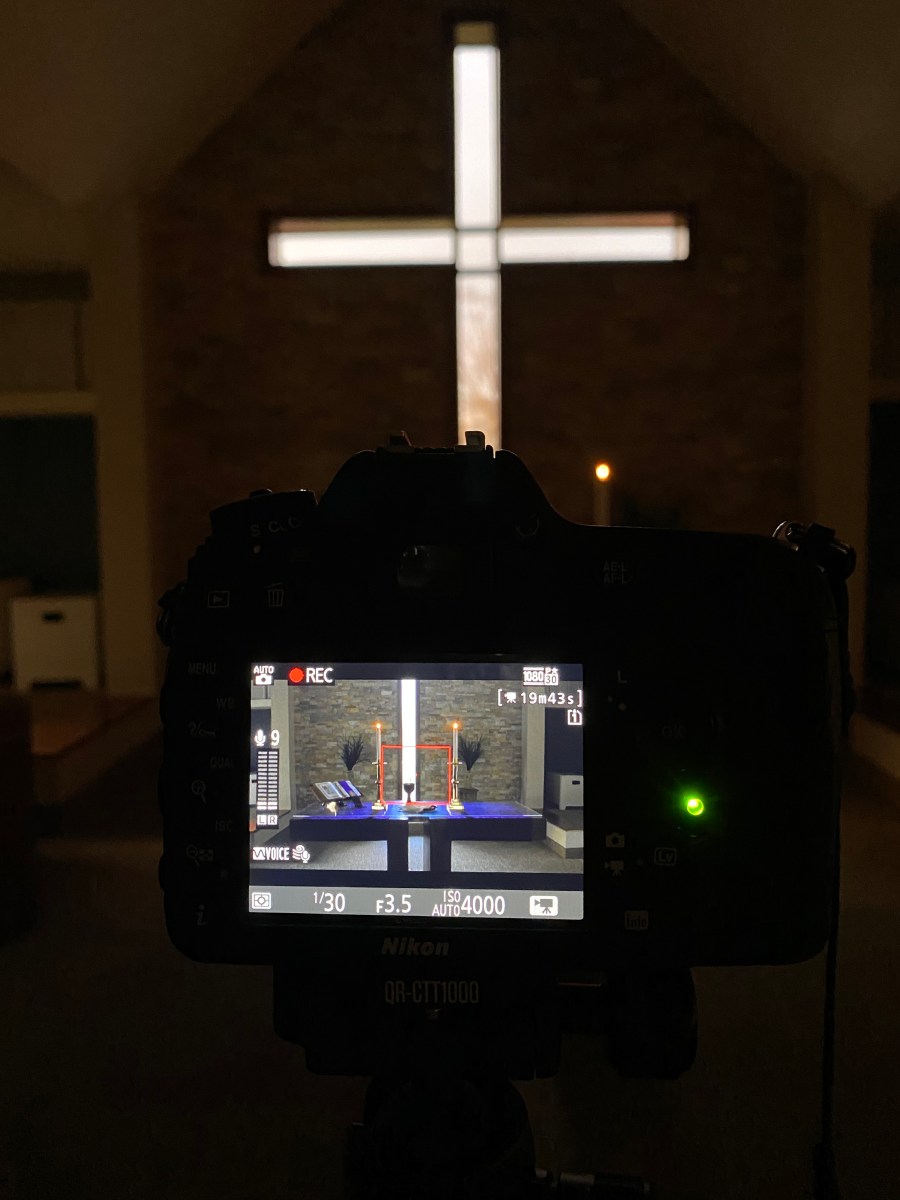
When I took today’s picture, I was staging images for use last Easter – Virtual Holy Week 1.0, if you will. I was thinking at the time that these things would be good reminders of that crazy, singular time that we were in. It was all new and scary; in the first weeks of the pandemic we were saying things like “well, if we are still doing this by Easter…”

And here we are, about to do it again.

The last two weeks have been difficult; for me and, I’m learning, for quite a few others. I’m chalking it up to emotional exhaustion; hitting that one year wall. I read an article the other day about how the 3/4 mark has proven to be the worst for people living through extreme situations, and that felt about right too.

Willis and I were talking this week about how things are going in his classroom; as a high school choir teacher he is now in the classroom 4 days a week, teaching concurrently to the handful of hybrid students in the room with him and the frequently faceless avatars in the google meet.

It’s awful, is how its going.

He was lamenting the very valid, career altering and emotionally devastating things that he and a lot of the fine arts teachers (all teachers, honestly) are facing right now. And as he was talking, he said something that really stuck with me: “I haven’t lost anyone to the virus, I know I shouldn’t complain, it isn’t that bad.”

I know that perspective is important, crucial even. But my (potentially unpopular) opinion is that over the last year we have nearly weaponized that concept. There have been very real consequences in the last year – very real traumas. There has been an absolutely horrific loss of life, yes, but there are many living in worlds they wouldn’t have chosen for their worst enemy a year ago.

Maybe rather than dismissing our sorrow as not being valid because our loss isn’t significant enough, the perspective we need is that maybe, in some ways, it is that bad. It is ok to look at ourselves in the (hopefully) last quarter of this trial and wish everything was entirely different.

Should we dwell in that? Of course not. But knowing that you have been wounded by circumstances far out of your control is the first part of being able to accept it, and eventually heal.

Looking back on this picture today, I am struck by the brightness of the image in the viewfinder compared to the rest of the room. It was very dark that evening, and with the right perspective the camera was able to use the window and the candles in a really beautiful way.

But it really was dark in the room, and if we hadn’t acknowledged that, we wouldn’t have known what to adjust to find the light.